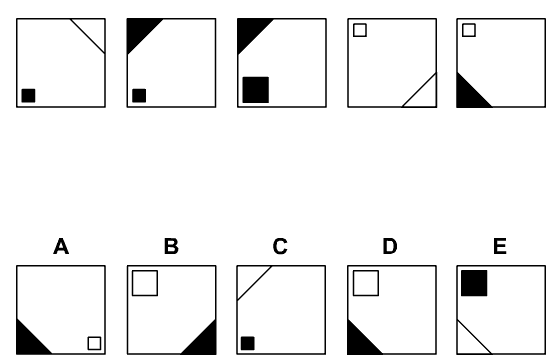
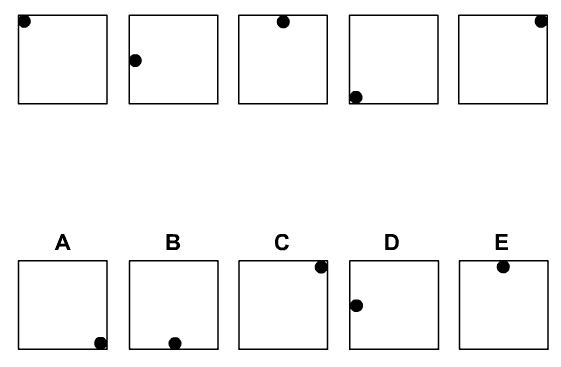
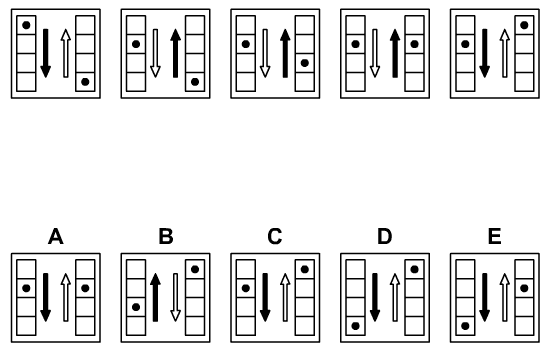
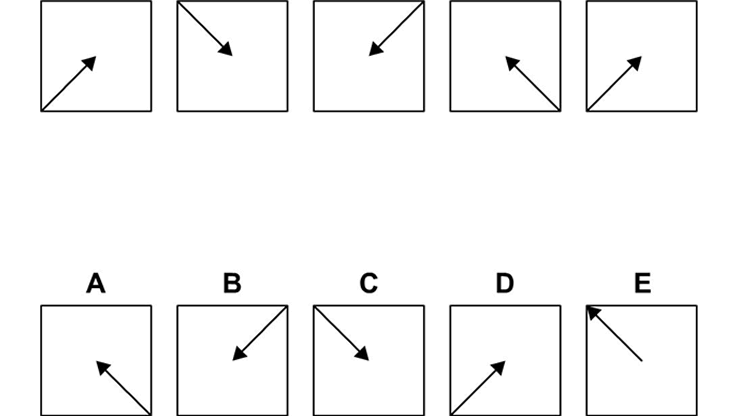
Estas 10 preguntas son la prueba de ejemplo que la EPSO publicó para las oposiciones AD (administradores). Cuatro de ellas aparecen también en el conjunto para asistentes de abajo.
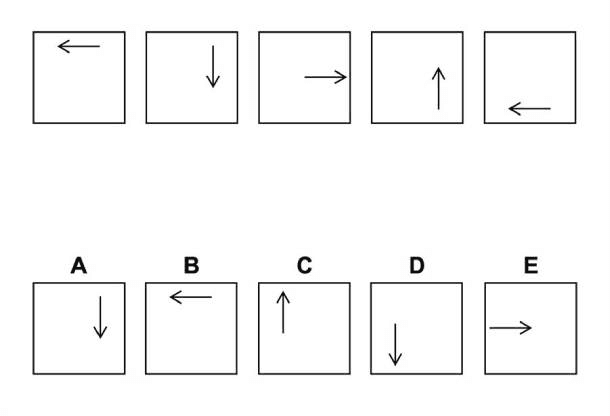
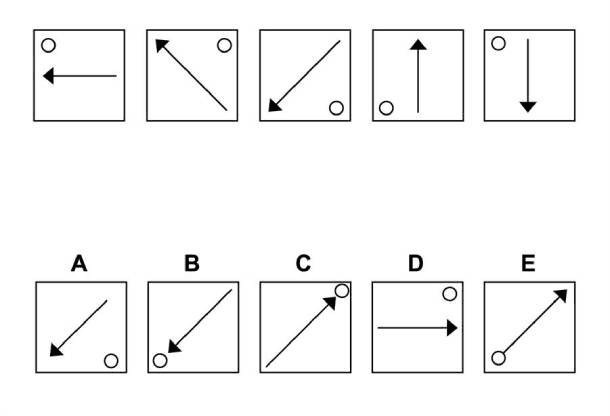
Elementos en juego. A single arrow pivoting inside a fixed square. Track the head's angle from frame to frame and the direction of travel stays constant; the step size is what has to be read off correctly.
AD-02
Mostrar la respuesta
Clave de la EPSOC
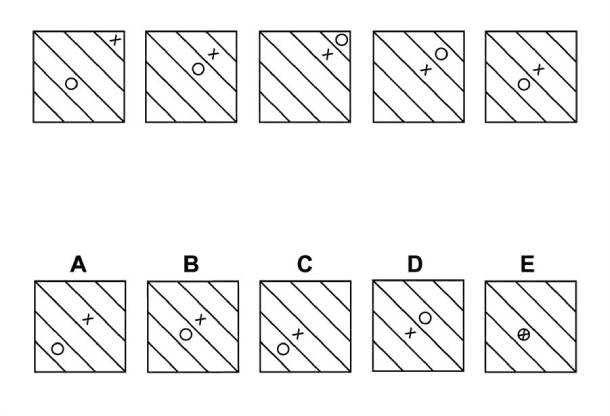
Elementos en juego. A diagonally hatched square holding a small cross and a small circle. The hatching is identical in all five frames: both moving parts are the two marks, which travel across the square and swap which of them sits ahead of the other.
AD-03
Mostrar la respuesta
Clave de la EPSOD
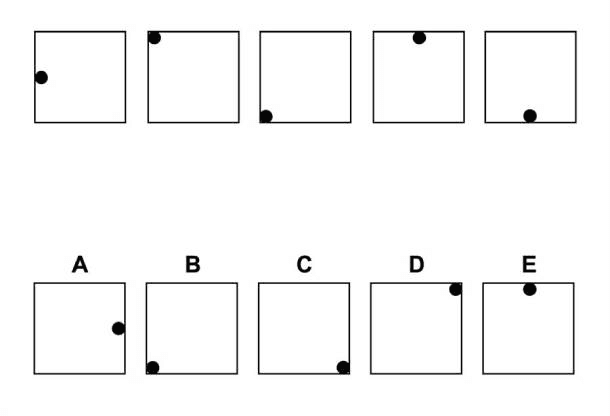
Elementos en juego. One dot walks the perimeter of the frame. The trap is the corners: the spacing between successive positions is even in distance travelled, not in visual displacement.
AD-04
Mostrar la respuesta
Clave de la EPSOD
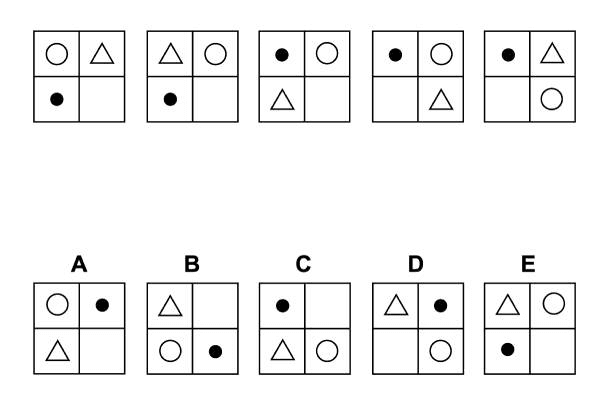
Elementos en juego. A two-by-two grid holding three symbols, an open circle, a triangle and a filled dot, with one cell left empty in every frame. Nothing is added or removed: the symbols change cells, so the rule is the order they cycle through. EPSO reused this item in three separate publications, which makes it the most widely reprinted official abstract item in existence.
AD-05
Mostrar la respuesta
Clave de la EPSOC
Elementos en juego. A long arrow that turns from frame to frame while a single small circle moves between the corners of the square. Two independent cycles, the arrow's direction and the corner the circle occupies, and nothing accumulates: there is exactly one circle in every frame.
AD-06
Mostrar la respuesta
Clave de la EPSOC
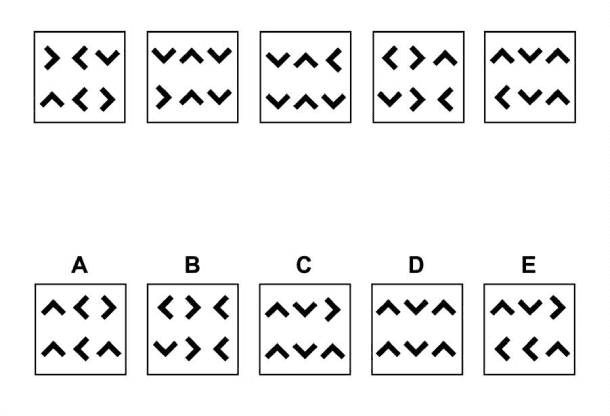
Elementos en juego. A two-by-three block of chevrons. Each frame flips a subset of them; the governing rule is which subset, not how many.
AD-07
Mostrar la respuesta
Clave de la EPSOC
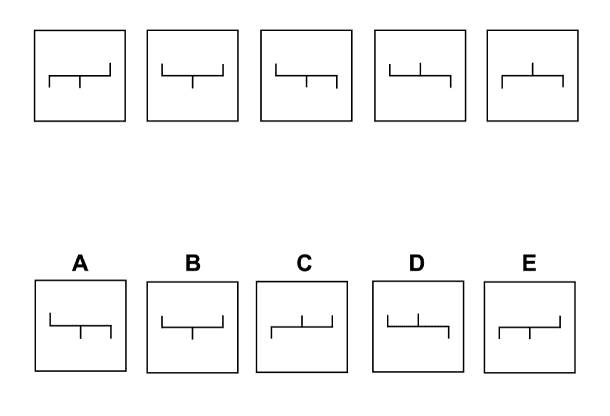
Elementos en juego. A stepped ledge line that lengthens and shifts. The vertical and horizontal components advance independently, so reading only the silhouette is not enough.
AD-08
Mostrar la respuesta
Clave de la EPSOE
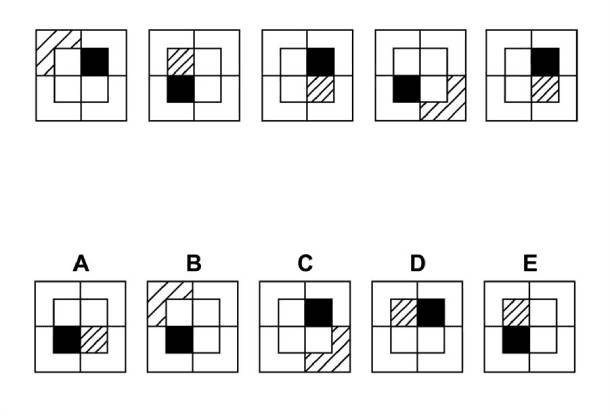
Elementos en juego. A quartered square with a second, smaller square overlapping it off-centre. The nesting never deepens, there are two squares throughout. What moves is the inner square's position and, with it, one solid black cell and one hatched cell shifting around the quarters.
AD-09
Mostrar la respuesta
Clave de la EPSOC
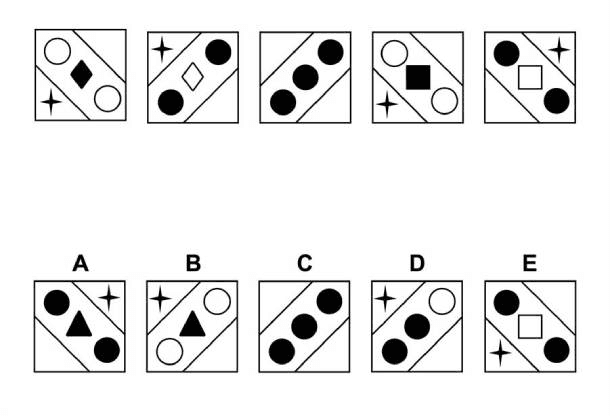
Elementos en juego. A diagonal band crossed by small shapes. The band's angle is fixed; what changes is which shapes sit on which side of it.
AD-10
Mostrar la respuesta
Clave de la EPSOA
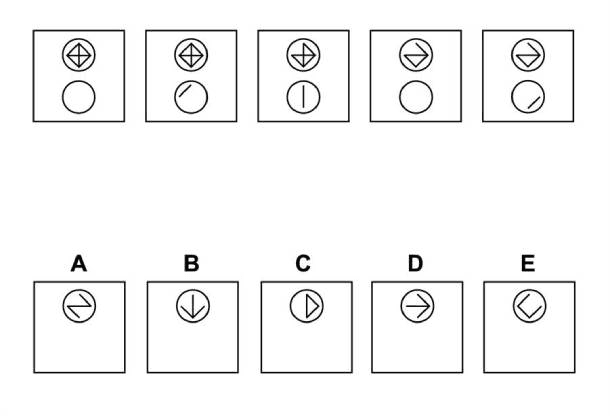
Elementos en juego. Two circles, one above the other, in a fixed panel. The upper one carries an arrow that turns; the lower one carries a straight line that turns on its own cycle and is absent altogether in some frames. The circles themselves never move, so there is no relation between them to read, only the two rotations.
El conjunto para asistentes
Estas 6 preguntas forman el conjunto para asistentes, usado en las oposiciones AST, AST/SC y CAST FG II. Las otras cuatro del conjunto de la EPSO repiten las preguntas para administradores de arriba.
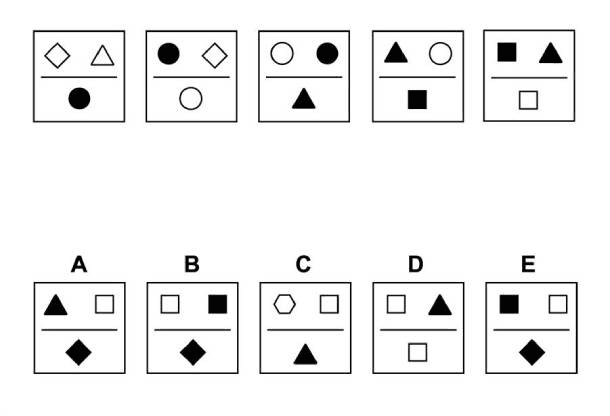
Elementos en juego. Shapes that alternate outline and fill while shifting position. Alternation and translation run on different periods.
AST-03
Mostrar la respuesta
Clave de la EPSOE
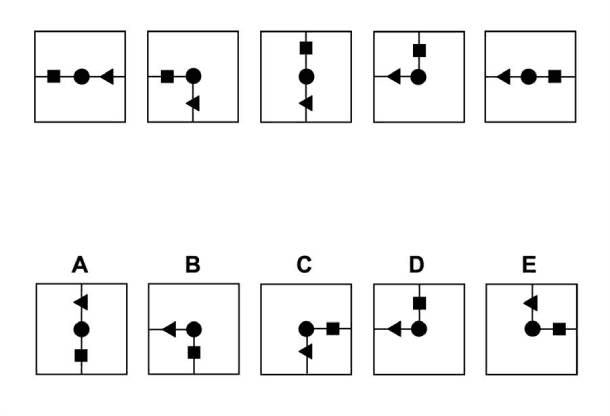
Elementos en juego. A circle at the centre of a straight arm, carrying a square at one end and an arrowhead at the other. The set of pieces never grows: what changes is the arm's orientation and which end each piece occupies.
AST-04
Mostrar la respuesta
Clave de la EPSOB
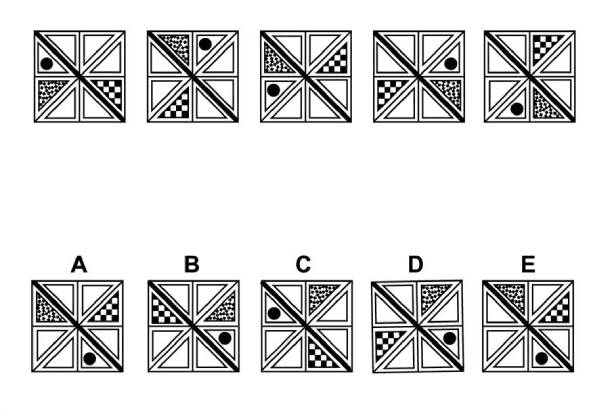
Elementos en juego. Pinwheel forms with distinct textures per blade. The rotation is obvious; the texture sequence carried around with it is the actual rule.
AST-05
Mostrar la respuesta
Clave de la EPSOC
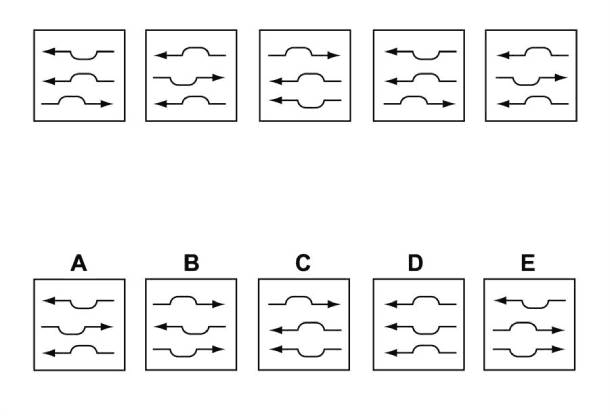
Elementos en juego. Three rows of wavy arrows. Each row advances on its own, and the answer depends on reading all three rather than the most eye-catching one.
AST-09
Mostrar la respuesta
Clave de la EPSOA
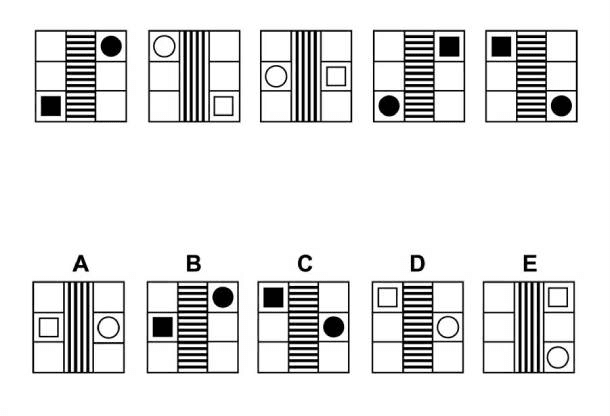
Elementos en juego. A three-by-three grid whose middle column is hatched. That column never moves, only the direction of its hatching changes, vertical in the early frames and horizontal later. The outer columns hold one small shape each, always placed symmetrically about the centre of the grid, and their row, their outline-or-solid state and which shape sits on which side all change from frame to frame.
AST-10
Mostrar la respuesta
Clave de la EPSOD
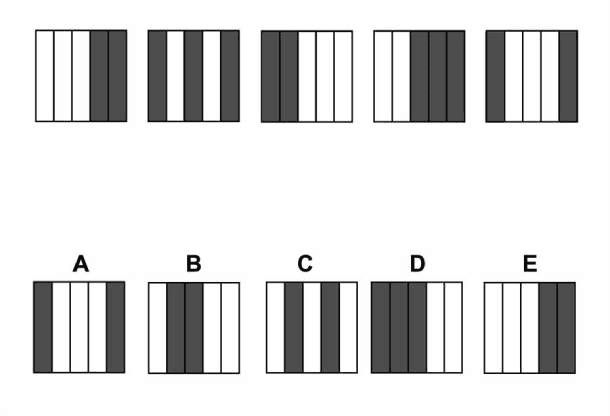
Elementos en juego. Five vertical bars of equal height, each either white or dark. Height never varies at all: the rule is entirely in which bars are shaded and how that pattern shifts along the row.
El folleto de 2010
Estas 3 preguntas proceden de la muestra que la EPSO publicó cuando se introdujo el razonamiento abstracto en 2010. Solo existen en inglés, francés y alemán.
Elementos en juego. The first item of the 2009 DIT_6 booklet, published when abstract reasoning entered the competition. Identical figure in the English, French and German editions.
LEG-02
Mostrar la respuesta
Clave de la EPSOB
Elementos en juego. Second booklet item. The older figures are line-drawn at lower resolution than the current set but follow exactly the same five-frame, five-option format.
LEG-03
Mostrar la respuesta
Clave de la EPSOB
Elementos en juego. Third and last booklet item. EPSO published only three legacy examples in total, against ten in each current set.
La demo retirada
Esta pregunta procede de la demo retirada del examen por ordenador de la EPSO. Es la única pregunta oficial para la que la EPSO nunca publicó respuesta.
Elementos en juego. Screen three of the retired computer-based-testing walkthrough, shown inside a replica of the Prometric interface candidates actually sat. The demo carried no answer sheet, so this is the only official EPSO abstract item with no published key.